
Ongoing Research Projects
Gender, Agribusiness, and Policy Innovations
Localizing SDG 5: Insights and Action
This project focuses on Sustainable Development Goal 5 (SDG 5) – Gender Equality, which aims to empower all women and girls by ensuring equal rights, opportunities, and treatment across various domains. Achieving ge nder parity in education, healthcare, employment, and political and economic decision-making is crucial for fostering sustainable development and enhancing overall societal well-being.
To provide a granular and data-driven understanding of gender equality, this study consolidates district-level gender indicators into district and state profiles for 792 districts across 36 states and union territories. These profiles are based on district names from the Integrated Government Online Directory, integrate key indicators from the National Indicator Framework (NIF) to offer insights beyond national and state-level assessments.
- Scope of Analysis
By focusing on district-level data, this analysis captures local nuances in demographics, economic activities, infrastructure, and social indicators that might otherwise be masked at the state level due to aggregation. The magnitude of variation among districts within a single state can be significant, with some districts facing greater challenges or opportunities in terms of women’s empowerment.
This refined level of analysis allows policymakers to design and implement targeted interventions, addressing specific regional disparities and ensuring a more equitable allocation of resources
- Data Sources
The analysis draws from multiple secondary data sources, covering key aspects of gender equality:
- National Family Health Survey (NFHS-5): Data from two rounds (2015-16 and 2019-21).
- Crime Data: National Crime Records Bureau (NCRB) reports from 2014 to 2022.
- Political Participation Data: Election Commission of India records, focusing on State Legislative Assembly elections over the past 10 years (wherever available).
- Economic Participation Data: Periodic Labour Force Survey (PLFS) datasets from 2017-2022.
- Time Use Data: Time Use Survey (TUS) conducted by MoSPI (2019) capturing gender-based time allocation patterns.
By leveraging district-level insights, this project provides actionable intelligence for evidence-based policymaking, helping stakeholders develop localized strategies to bridge gender gaps and promote women’s empowerment across India.
This refined level of analysis allows policymakers to design and implement targeted interventions, addressing specific regional disparities and ensuring a more equitable allocation of resources
The Women Entrepreneurship Platform (WEP)
India’s flagship digital ecosystem and capacity-building initiative for women entrepreneurs. It functions as a one-stop national hub that aggregates information, resources, mentorship, training, financial access, and market linkages to support women-led enterprises across stages of the entrepreneurial lifecycle. By integrating government initiatives with private-sector and ecosystem partners, WEP aims to accelerate women-led development and reduce systemic gender gaps in entrepreneurship.
WEP operates as a Digital Public Good that is open and inclusive, and scalable. It is free to use and integrates with existing government digital infrastructure, such as Udyam registration and Jan Dhan accounts. Its modular architecture allows customisation by language, region and sector.
- Scope of Analysis
The analysis will examine the progress made so far by the Women Entrepreneurship Platform. Both qualitative and quantitative data has been utilised to understand the programs run by the platform, its reach, execution, and impact. These analysis looks at the connection between WEP’s intended outcome pathways and the observed programs’ early outcomes.
- Resources Used
Administrative Platform Data WEP’s to get insights into program reach and participation, and user experience.
Qualitative Interviews were conducted with stakeholders’ including women entrepreneurs, mentors, program partners, program implementation partners, and steering committee members to get insights into WEP’s ecosystem functioning.
Statement of Intent (SOIs), platform registration, and ATR registration forms were reviewed to understand the partners’ program engagements and beneficiary enrollment methods on the platform.
Relevant literature and policy documents were reviewed as the secondary sources to understand the policy context and ecosystem on women entrepreneurship in India.
- Impact
With our recommendations based on a systematic analysis of the WEP’s organizational structure, marquee assets, and its activities, the platform can strengthen its effectiveness and long-term sustainability.
Empowering Women in Rural Agrarian Economy In Bihar
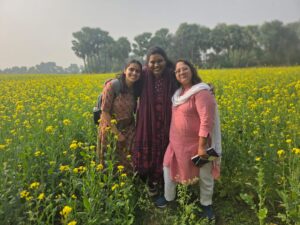
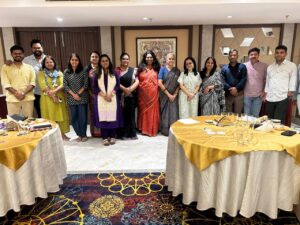
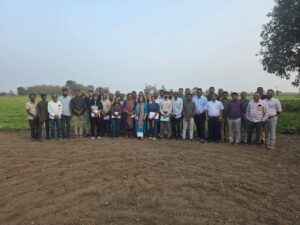
This project focuses on improving the nutrition and livelihoods of rural women and young children in Bihar, where malnutrition and anaemia remain persistent challenges. It recognises that women face a dual burden of childcare and income generation, which limits their ability to ensure proper nutrition for themselves and their families. The intervention introduces community-based creches to reduce women’s caregiving responsibilities and free up their time.
The project is implemented in the districts of Katihar and Gaya, which have high levels of undernutrition and service delivery gaps. It examines how pathways such as time availability, income opportunities, and nutrition knowledge influence outcomes.
The study uses structured data collection tools, including baseline surveys, dietary recalls, and anthropometric measurements. It evaluates both women’s and children’s dietary diversity and health indicators.
Implemented in collaboration with organisations such as SEWA Bharat and Ekjut, the project also assesses the demand for childcare services and the willingness to pay. Overall, the project aims to improve nutritional outcomes while empowering women economically and socially.
By conducting a baseline survey before the introduction or strengthening of creche services and a corresponding endline survey after implementation, the study can rigorously evaluate changes in key outcomes such as women’s time use, labour force participation, childcare practices, and nutritional status of both mothers and children.
Women's Agency in Community-Managed Natural Farming in Andhra
Andhra Pradesh’s Community-Managed Natural Farming programme (APCNF) has built something different. By routing agricultural support through women’s Self-Help Groups rather than conventional farmer organisations, APCNF has created conditions where over 1.29 million farmers and 12,000+ community cadres (roughly two-thirds of them women) participate in one of the world’s largest agroecological transitions. The programme’s institutional architecture, layering technical agricultural roles onto existing women’s collective action networks, has no real precedent at this scale.
In this research collaboration between IIMA and RySS, we investigate what happens to women’s agency when an agricultural programme is structured around them.
WHAT WE ARE STUDYING
At its core, the research treats agency as something richer than a binary. Women are not simply “empowered” or “not empowered.” Their confidence, decision-making authority, voice in community institutions, control over their own time, and economic standing each move at different speeds and respond to different conditions. We are interested in how these dimensions interact, which shift first, and what programme and household conditions shape the trajectory.
The study also examines how gender shapes the spread of farming knowledge, why natural farming appears to hold particular appeal for women, and what determines whether a woman sustains new practices or reverts to older ones. For women entering agricultural enterprises, we investigate which combination of support actually translates into viable, sustainable businesses rather than short-lived experiments.
RESOURCES
The field research is conducted across multiple districts in Andhra Pradesh in close collaboration with RySS, which provides programme-level access and field coordination. The research design combines quantitative and qualitative approaches at scale.
IMPACT
For the programme: The research is designed to produce evidence that RySS can act on directly: insights into how extension delivery, messaging, leadership development, and enterprise support can be refined to strengthen outcomes for women. Every finding is oriented towards operational use, not just academic contribution.
For policy: India’s National Mission on Natural Farming is scaling from Andhra Pradesh to a national programme. This research provides evidence on what institutional features produce real agency gains, and how programme design choices travel (or fail to travel) across contexts. The findings are intended to inform both the state and central government as scaling decisions are made.
For the field: The study contributes to active academic debates on the relationship between agroecological transitions and women’s empowerment, the role of institutional design in shaping collective action, and the measurement of agency itself. We challenge the frameworks that still dominate this literature and propose alternatives grounded in women’s actual experiences.